

How To Draw Celtic Knots Cross
How to describe Celtic knotwork 3 – REPEATS Make INTERLACE
Happy so far? :-)
This 3rd page on how to draw Celtic knotwork depends on your kickoff knowing about crossed cords every bit the bones unit and also how to bring together cords to finish off a knot.
At present for how to make your Celtic knot literally as long as a slice of string.
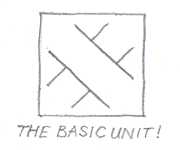
The simple crossed-cords-in-a-foursquare unit of measurement repeats very hands to create long twists, plaits or sections of interlace. Hither's the bones two-crossed-cords-in-a-square unit once more:
And here is the same, bones unit of the Celtic knot joined up with another, identical unit of measurement placed alongside it:
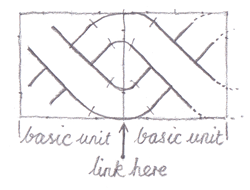
Discover that when y'all are repeating units similar this, you lot don't need to add whatsoever extra space in between in order to bring together cords (unlike the ends of knots). You but 'scoop' the line round and it joins up. (Joining cords to finish off the ends of knots is covered in more detail back in the 2d page of the tutorial.)
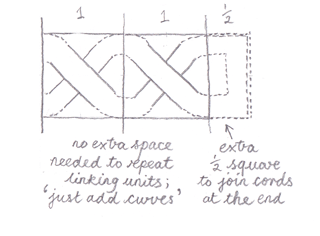
So hither is the first piece of Celtic decoration that can be made. It'southward the basic unit joined with several others to create the simplest possible version of a plait – a ii-strand twist:
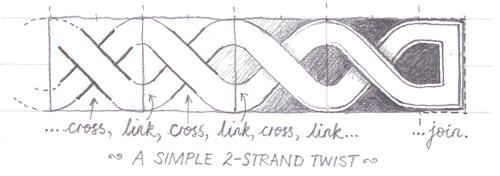
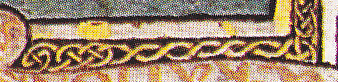
It's pretty enough and information technology makes a squeamish edge; and it's used in the original Celtic manuscripts to fill narrow, pointed spaces, as in this example from the Canterbury Codex Aureus:
But it doesn't look much ... a chip like watching someone juggling two balls. And information technology gives the impression you could merely unravel information technology with a flick of the wrist.
Nevertheless, this ii-cord twist is a vital step on the fashion to learning how to depict Celtic knotwork of far greater scope and ambition.
You can see that some of the aforementioned rules apply for repeating a pattern that we saw in joining cord-ends. Information technology helps if you don't draw the original crossed cords as well close to the edges of the square they sit in. That way, y'all can draw smooth curves to join the cords, without kinks or irregularities.
Doubling upward a two-strand twist
And then far, you may experience that we take twisted lots of $.25 of string into nothing very impressive in terms of how to draw Celtic knotwork. But what happens if nosotros repeat the same uncomplicated crossed-cords unitupwards equally well as along?
What y'all're doing here is running another twist along the top of the one you've already got. Then, you're just extending the lines of the bottom row of crossed cords then that they meet upwards with -- and become -- cords in the top row.
At the edges, cords turn back into the plait again. In the middle, cords keep going in straight lines if they maybe can.
Like this:
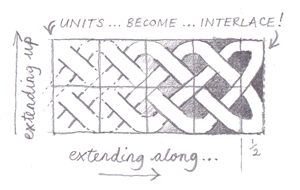
By golly, it's a four-strand plait! – a department of woven border! Why, that's almost all you demand to know about how to draw Celtic knotwork!
If you don't find that exciting … well, fine.
To be serious: this is also the time to notice anevery of import betoken which applies toany 'how to depict Celtic knotwork' method:
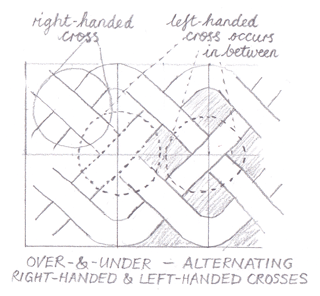
What goes overmust become under; what goes undermust go over.
A cord which has crossed over the top of another stringmust gounder the adjacent cord it encounters, and vice versa. It'south a strict rule for interlace patterns.
Remember you drew your original two-crossed-cords-in-a-square equally right-handed crosses? Now where your cords join upwardly they must class left-handed crosses staggered in between the original right-handed crosses. Over and under, over and under is the unvarying rule.
Take another look:
So, whenever y'all find yourself wondering how to draw Celtic knotwork, use the following rules.
If crossed cords are right-handed in the middle of a square, they are left-handed where 4 squares meet upwardly (and vice versa, if they're left-handed in the middle of a square, they're right-handed where the corners of the squares come across).
Another way of looking at it is that if the cords cross right-handed forth the edge of a plait or design, they'll cross left-handed 'up a level and along one', and they'll cross right-handed once again on top of that.
If you oasis't already washed and then, now'due south the time for you lot to demonstrate how to draw Celtic knotwork ... well, interlace, anyway.
Showtime, draw six squares in a block of three by two:
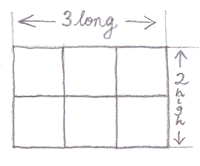
Add together 2 half-squares down the left-hand and right-hand edges, in which to join up the ends:
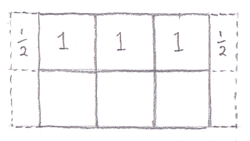
Then draw six right-handed crossed cords, ane in each box, remembering not to go right to the edges. (If yous're non sure of this chemical element of Celtic drawing, run into the [before] tutorial page):
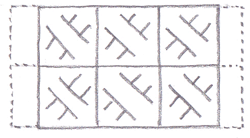
And so describe the left-handed crossed cords that go in betwixt, on superlative of the places where the square boxes encounter up:
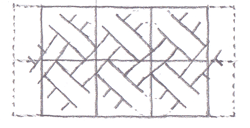
Then join upward all the ends along the edges past drawing smooth curves between the exterior lines and so smaller curves between the inside line. This element of Celtic drawing governs the final 'flow' of the knot. Keep the cord-width constant:
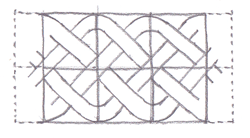
Then bring together upwards the ends in the half-squares. The top cord in the top row joins the top cord in the bottom row; the bottom cord in the top row joins the bottom cord in the bottom row. Like this:
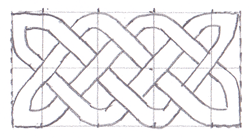
Check your cords are all going over-and-under-and-over-and-under. If not, cheque the earlier steps for where the cartoon went wrong, and correct information technology, or beginning over again.
If all's well, colour in the fiddling spaces betwixt the cords, and rub out whatever construction lines (the lines of the original squares):
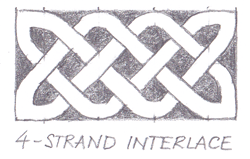
Congratulations. You lot take (I hope) just produced a piece of 18-carat Celtic cartoon. Information technology's not quite patterned knotwork yet, only it's very close indeed, and information technology'south authentic Celtic decoration.
There's i important page left -- on how to describe more interesting Celtic knotwork patterns past introducing breaks into the weaving.

Source: https://www.calligraphy-skills.com/how-to-draw-celtic-knotwork.html
Posted by: meiergrased.blogspot.com
0 Response to "How To Draw Celtic Knots Cross"
Post a Comment